
Local Government Innovation, Not Wealth, Predicts How Long Indonesians Live
Technology and Innovation in Indonesia’s 514 kabupaten and kota is twice as strong a predictor of citizen longevity as local GDP per capita. This finding has direct implications for where governments and development partners choose to focus their efforts to improve public health.
Kabupaten Lamongan and Kabupaten Sukabumi both sit well below the national average in GDP per capita. Yet people in these regencies live longer than in most other regencies at a comparable level of economic development. What they share is not wealth, but the quality of their governance.
Lamongan and Sukabumi are not outliers. This pattern holds across all 514 of Indonesia’s regencies (kabupaten) and cities (kota). Data from the Regional Government Success Scorecard (RGSS) – a new data-driven tool developed by the Chandler Governance Group (CGG), supported by the Gates Foundation, and piloted in Indonesia with Universitas Indonesia – shows that quality of local governance is a far stronger predictor of how long citizens live than the wealth of the region they live in. This study drew on nearly 18,000 data points from Indonesian government sources, predominantly from 2024.
What the data shows
The strongest finding in the RGSS pilot is the relationship between a local government’s Technology and Innovation capability and the life expectancy of its population. Technology and Innovation is one of four government capability dimensions that the RGSS measures; it captures the maturity of digital government services as assessed through Indonesia’s national SPBE (Sistem Pemerintahan Berbasis Elektronik) framework, and institutional innovation capacity through the Ministry of Home Affairs’ regional innovation index. The correlation between Technology and Innovation scores and life expectancy across all 514 jurisdictions is 0.63, a figure comparable in strength to the internationally well-established relationship between years of schooling and adult earnings, and a strong signal by the standards of social research.
The contrast with economic wealth sharpens the picture. GDP per capita across Indonesia’s regions varies widely – from around Rp 7 million per person in Kabupaten Puncak Jaya, in Papua Tengah province, to more than Rp 260 million in Kota Surabaya, the capital of East Java. Given that range, one might expect wealth to be a powerful predictor of how long people live. The data, however, tells a more nuanced story. The correlation between GDP per capita and life expectancy is 0.32, roughly half the strength of the Technology and Innovation link. This governance capability explains approximately four times the variation in life expectancy that wealth does. Some of the best-governed, longest-lived communities in Indonesia are far from the richest.
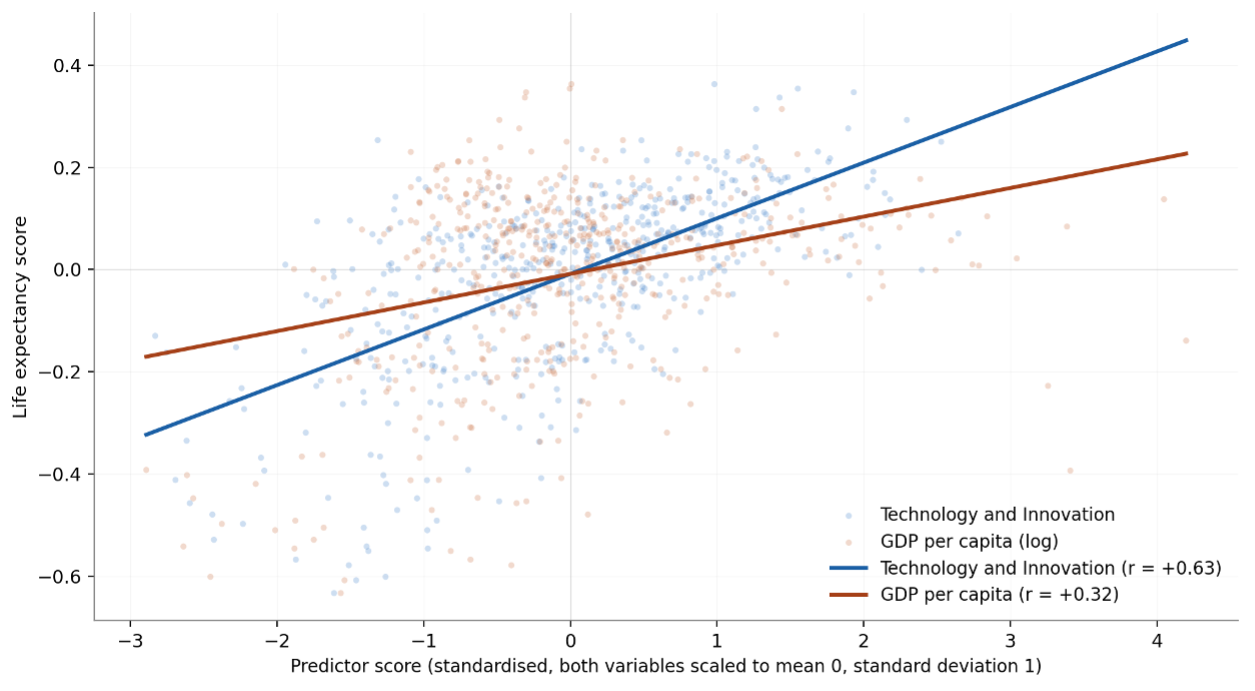
Each kabupaten or kota appears twice on the chart: as a blue dot at its standardised Technology and Innovation score, and as an orange dot at its standardised log-GDP-per-capita score. Both variables are scaled for direct comparison. The Technology and Innovation trendline rises roughly twice as steeply as the GDP trendline.
The chart makes this contrast visible. Jurisdictions with stronger Technology and Innovation scores reliably record longer-lived populations. The GDP relationship is weaker and more dispersed.
What this looks like in practice
Kabupaten Lamongan in East Java illustrates the pattern well. With a GDP per capita at the 31st percentile nationally, it sits at the 98th percentile for Technology and Innovation and the 90th percentile for life expectancy outcomes. Kabupaten Sukabumi, with a GDP per capita at the 18th percentile, sits at the 96th percentile for Technology and Innovation, and in the 95th percentile for life expectancy outcomes. These cases point to the same conclusion: local governments that have built government capabilities to deliver public health outcomes are able to do so despite structural economic disadvantage.
The two indicators behind Technology and Innovation – SPBE and the regional innovation index – assess how effectively local governments have embedded digital tools into service delivery and administration, and how institutionally innovative they are in solving public problems. These capabilities help to improve public services and reduce the cost and time citizens spend accessing them. They can also help local governments to act on public health evidence, deploy resources efficiently and continuously improve.
The relationship between Technology and Innovation capability and life expectancy is consistent and statistically robust, but these correlations identify patterns, not causes. Life expectancy is shaped by many factors, such as health spending, geography and social conditions. These are questions that warrant further research as richer data becomes available. What the RGSS pilot does show is that governance capability, particularly Technology and Innovation, is more consistently associated with longer-lived populations than economic wealth. It is a meaningful signal for informing where investments and improvement efforts are directed.
What this means for planning, investment, and policy
The RGSS was designed to give central agencies, development partners and local governments a more rigorous and structured basis for planning where capability-building investment will have the most impact. The full RGSS dataset, covering all 514 jurisdictions, is publicly available at www.regionalgovscorecard.org.
After more than two decades of decentralisation, Indonesia’s 514 local governments operate in very different contexts, with evidence on their performance remaining rich but scattered across multiple sources. The RGSS brings this evidence together in a structured way, helping us better understand what enables local governments to perform well and learn from one another’s experience. Investment in local government capability, and in Technology and Innovation in particular, represents a promising and evidence-backed focus for improving how long Indonesians live.
About the Regional Government Success Scorecard (RGSS)
The Regional Government Success Scorecard (RGSS) is a diagnostic tool developed by the Chandler Governance Group (CGG) to identify the key drivers of local government success, supporting better planning, policymaking, and resource allocation. Developed with support from the Gates Foundation and piloted in Indonesia in partnership with the Institute for Economic and Social Research, Faculty of Economics and Business, Universitas Indonesia (LPEM FEB UI), the RGSS scores all 514 of Indonesia’s kabupaten and kota across four dimensions: Inputs, Capabilities, Performance, and Foundational Environment.
Related Articles

Leadership & Foresight